Threefold 11
herbaria, pressing flowers, and Bobby

Welcome to the Threefold Letter. This month, reading deeply about herbaria, beginning to make one, and an update on a bobtailed bobcat Bobby.
---fold here---
There still isn’t a lot of making happening recently. Now though, instead of the weather, it is due to a sense of limbo of many things on the cusp of happening. More on that in a future issue. For now, the topic is herbaria, and I’ve been reading a lot about them. How they started, the history, the making, the thinking, the exploring, the engaging. Who knows when my interest started. Possibly with pressing flowers as a child (especially pansies), or perhaps with Emily Dickinson’s herbarium, which I’ve mentioned in this newsletter before (issue 09). In January of this year, I e-attended a lecture with the London Group of Historical Geographers: Herbaria as places of/with memory: research transatlantic exchange between European and Andean Cities, by Diego Molina. He talked about herbaria as multidimensional memory places “an apparatus of human and non-human, individual and collective memories,” holding collector’s memories, plant memories, and place memories. The interweaving of different memories, and the human-plant relationship, are ideas I’m keen to explore..
In this last month I have returned to my notes on the Molina lecture, and to a book I read two years ago, Herbarium: A Quest to Preserve & Classify the World’s Plants by Barbara M. Thiers, and I have built on that reading list with a few more excellent and intriguing reads. These are the books where my thinking has been this month.
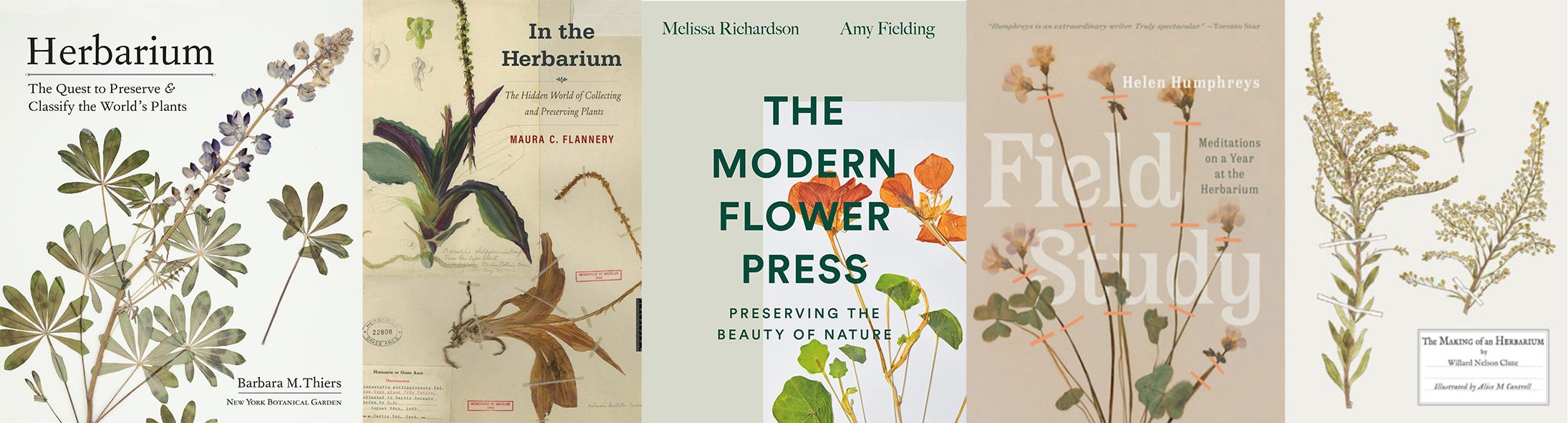
In the Herbarium, Flannery – the most academic of the books here. Traverses the history and development, key personalities, technologies, etc with in depth notes and a large bibliography.
The Modern Flower Press, Richardson & Fielding – a story of a collaborative art practice that revolves around pressed flowers. It includes some short explainers and project guides, as well as personal and wider anecdotes and stories about particular flowers and plants.
Field Study, Humphreys – a record of a poetic art practice of spending time and engaging with a specific herbarium: The Fowler Herbarium at Queen’s University in Ontario, Canada. It’s beautifully written and immersive in the aesthetic and the stories of the herbarium.
The Making of a Herbarium, Clute & Cantrell – this is a recent reprinting of a pamphlet book first published in 1904. Clute, in the affectations of the age (ie, somewhat snootily) describes the fundamentals of creating an amateur herbarium. Cantrell adds lovely illustrations and a couple of pages at the back providing contemporary variations to Clute’s paper and glue recommendations.
---fold here---
So, despite my paralytic limbo, I’ve started pressing flowers towards making my own herbarium. Clute describes a process of collecting specimens into a ‘collecting press’ and then moving them into a ‘drying press.’ After the specimens are fully dry (3 – 12 days) they can then be pasted onto specimen sheets. Pictured below are recently cut specimens from my garden, both are flowering beautifully right now: sage and woad. I’ve skipped Clute’s collecting press, because I picked them in my own garden, and I’ve put them straight into the drying press, otherwise known as a flower press. When they have fully dried, I will create my first herbarium sheets.


---fold here---
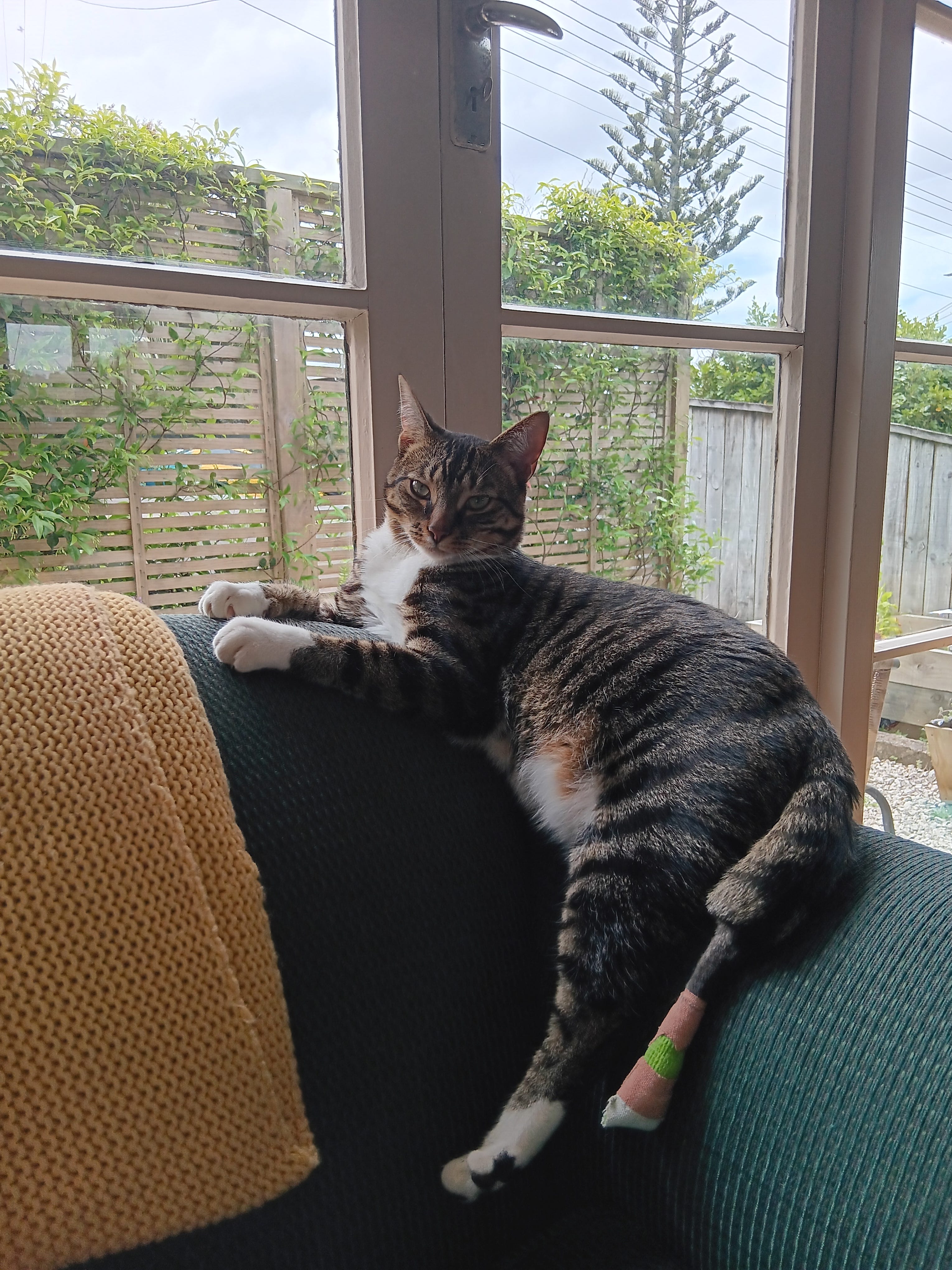
In a far less creative update, but one that has overtaken every other topic or event in my mind, is my little (but apparently not so little) cat Bobby. He got his tail caught in a window jamb (this was entirely my fault) and his poor tail was ‘degloved’ (that’s the vet’s term). The end of his tail was amputated at the emergency vet and he is now recovering well. He is so sweet and personable; he seems to have forgiven me completely or never blamed me at all. Here he is at his usual perch with his partially shaved and bandaged tail.